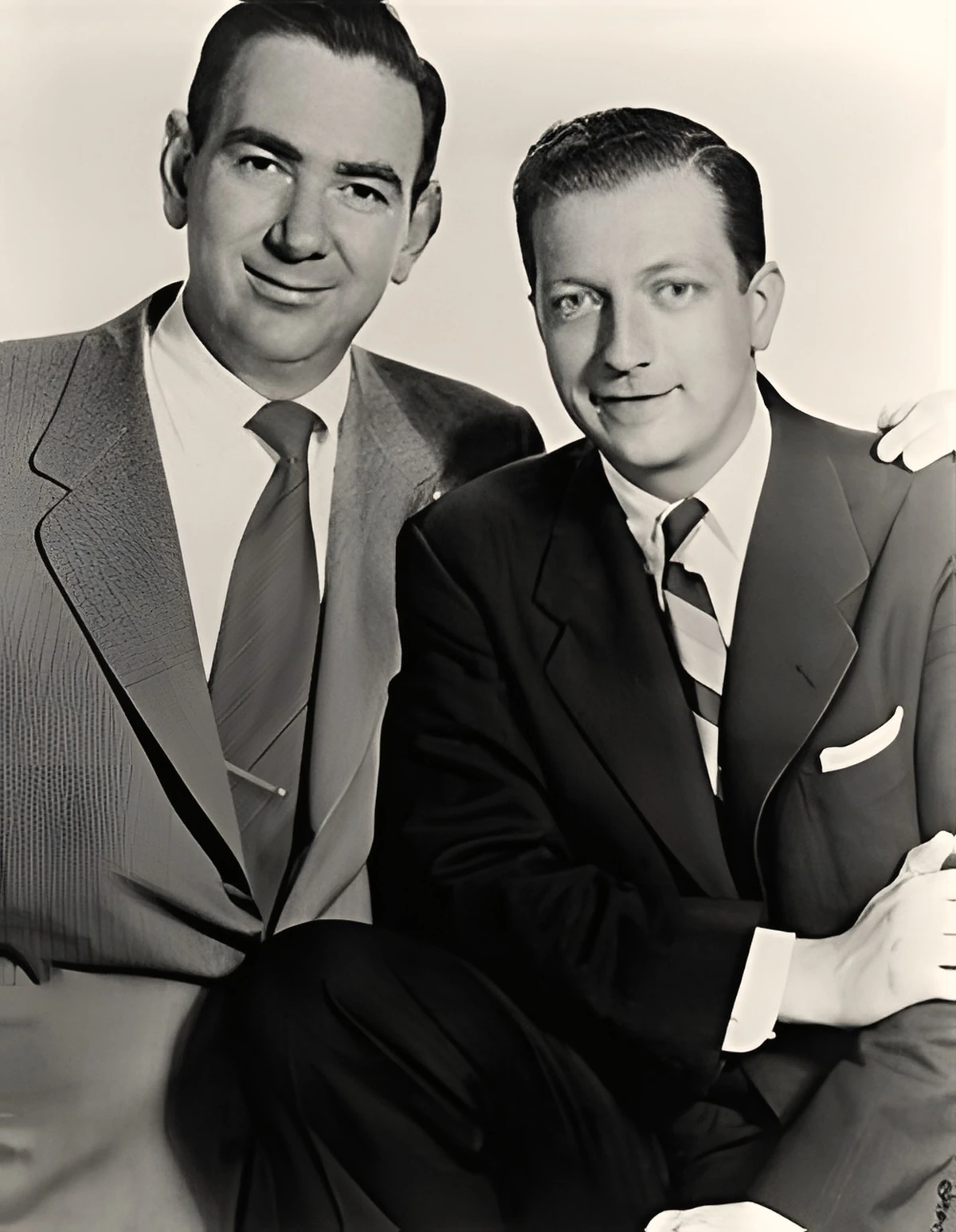
Bob & Ray
How It All Started
The whole thing began by accident, the way the best ideas usually do. Bob Elliott had landed a job at Boston's WHDH during World War II, returned after his military discharge, and was doing a morning disc jockey show when the station hired Ray Goulding to read the news on the hour. Goulding would wander over to Elliott's microphone after the news, an impromptu conversation would start, and something clicked. The two men discovered they could riff off each other in a way that was genuinely funny — not performed funny, but the kind of funny that comes from two people thinking on the same wavelength.
What really opened things up was baseball. When WHDH acquired the rights to Braves–Red Sox games, Bob and Ray were asked to fill 25 minutes before each broadcast. That kind of unstructured airtime, with nothing to fill it but instinct and mutual understanding, turned out to be exactly what they needed. The serial spoofs started there, beginning with a parody called "Linda Lovely" and eventually growing into the more polished "Mary Backstayge, Noble Wife," which borrowed the exact techniques — overwrought domestic drama, absurdly named characters, ponderous continuity — that Frank and Anne Hummert had built their real soap opera empire on. In "Mary Backstayge," the show lifted the Hummert habit of using an identifying adjective as a character's first name; the theatrical backer was "Wealthy Jacobus Pike," as if no one needed a given name when a personality trait would do.
By 1951, an agent had slipped an audition record to NBC executive Bud Barry, and Bob and Ray were on the national network. Within a year, they had won a Peabody Award — the first of three over the course of their career, with later wins in 1956 and 1982.
The Characters They Built
The show ran without a script for most of its life. Elliott and Goulding divided the character types between them based on something like vocal instinct: Goulding took the low, gruff parts, the roaring tough guys, and every falsetto female voice on the program. Elliott handled the adenoidal, the European-accented, the flat and the dull, and most of the old men. The arrangement was never rigid, but it was consistent enough that listeners knew immediately who was speaking.
Some of the recurring characters became genuinely elaborate creations. Wally Ballou, played by Elliott, was introduced as "radio's highly regarded Wally Ballou, winner of over seven international diction awards" — sometimes as "personable, well-preserved Wally Ballou" — and proceeded to demonstrate that he was one of the worst interviewers imaginable. His microphone was always off for the first few minutes of a remote broadcast. He talked over his guests, interrupted them, and asked questions they had just answered. He was always cut off at the end of a broadcast, mid-word. The joke was that Ballou had absolutely no awareness of how bad he was.
Goulding's Mary McGoon hosted a recipe and menu show and eventually spawned dozens of spinoff characters — Irma Shacktalloosengaard, Natalie Attired — all voiced identically, because Goulding had one female voice and committed to it. As Natalie Attired, Goulding played a "song-sayer" who spoke song lyrics to the accompaniment of drums. Mary McGoon made "mock turkey" each Thanksgiving: mashed potatoes molded into the shape of a bird, with hot dogs for drumsticks. In 1949, a Mary McGoon recording of "Mule Train" and "I'd Like to Be a Cow in Switzerland" sold out its 3,000-copy pressing and became a collector's item.
The sports parodies were equally sharp. Elliott's Steve Bosco was an often-inebriated sports reporter who worried constantly about being cut off the air and ended his segments with pleas for money — his signature sign-off, "This is Steve Bosco rounding third, and being thrown out at home," was a deadpan twist on Joe Nuxhall's real one. Goulding's Biff Burns was a sportscaster whose towering ego was matched only by an equally towering ignorance. At the height of the Arthur Godfrey craze, they created Arthur Sturdley, a redheaded talent scout host described plainly as "just a jerk." Elliott's Peter Gorey, voiced in a Peter Lorre register, kept reading the same gruesome news items each time — "Three men were run over by a steamroller today…" — and the duo would occasionally play a record of "Music! Music! Music!" supposedly sung by him.
The Satire and What It Was Aimed At
The show's targets were everywhere in American life, but radio itself was always the richest material. "One Feller's Family" was a spoof of Carlton E. Morse's serial "One Man's Family," with Elliott as Father Butcher endlessly muttering "Fanny, Fanny, Fanny" while Goulding's Mother Butcher shouted back "Oh, shut up and stop mumbling, you senile old man!" The show credited its script to "T. Wilson Messy" and billed itself as "a Messy Production."
"Mr. Treat, Chaser of Lost People" went after the Hummert detective serial "Mr. Keen, Tracer of Lost Persons." "The Gathering Dusk" was introduced as "the heartwarming story of a girl who's found unhappiness by leaving no stone unturned in her efforts to locate it," sponsored by the "Whippet Motor Car Company, observing the 45th anniversary of its disappearance." The fictional serial "Mary Backstayge, Noble Wife" had a listed writer, Chester Hasbrouck Frisbie, who discussed coming episodes — according to the New Yorker — as if talking about Proust or Joyce.
The fake premium giveaways were another running joke, and one that reportedly irritated J. Edgar Hoover. The "Little Jim Dandy Burglar Kit" drew his particular displeasure. Other bogus premiums included the "Bob and Ray Home Surgery Kit" and membership in "Heightwatchers International," which came with "six ample servings of low vitamins and nutrients in artificial colorings." When the Army–McCarthy hearings rolled around, Goulding's impersonation of Senator Joseph McCarthy fed a pointed series of sketches; Bob and Ray were perfectly happy to aim higher than radio when the moment called for it.
The CBS Years and the Best of the Run
The quarter-hour series that ran on CBS from June 29, 1959 to June 24, 1960 brought back the familiar characters — Mary, Tex, Wally Ballou, Steve Bosco — along with some new ones. Lawrence Fechtenberger, Interstellar Officer Candidate, was introduced with a sneering sidekick named Mug Mellish and was sponsored by "chocolate cookies with white stuff in between them." A tree imitator appeared with more than two dozen trees in his repertoire, including a sobbing rendition of a weeping willow. "The great Bob and Ray bird" was described as "a dangerous bird," doubled in size each week, and one day ate the "Bob and Ray popcorn ball."
The CBS show was coordinated by "Wilbur Conley, young squirt who works for us," and featured parodies of television laugh tracks, an audience "warmdown," and a game show segment called "Ladies, Grab Your Seats." It opened with: "And now, from approximately coast to coast, Bob Elliott and Ray Goulding present the CBS Radio Network." It closed with Goulding saying "This is Ray Goulding reminding you to write if you get work" and Elliott following with "…and Bob Elliott reminding you to hang by your thumbs."
Goulding once explained to Newsweek what radio could do that television couldn't: "All you have to do is say you're in Yankee Stadium; on TV, you'd have to have it painted on a wall." That instinct — that radio was a medium of suggestion, where a sentence could conjure what television had to build — ran through everything they did. The most prolific freelance writer on the run was Tom Koch, who in 1955 sent over ten bits from his perch on the Monitor staff; the duo bought eight, and as Koch remembered it, "The check would come and that would be it" — they never rejected another submission from him.
Beer, Broadway, and the Long Afternoon
The voice work spilled past the radio show. From December 1955 through 1960, Elliott and Goulding voiced the animated Bert and Harry Piel commercials, animated by UPA for the Young & Rubicam agency — Elliott as the tall, soft-spoken Harry and Goulding as the short, loudmouthed Bert. Time reported in 1960 that for three years of the campaign, Piel's beer sales set new records; the catch, as it later turned out, was that listeners would try the beer and find it disappointing. Whether the ads helped Piel's or hurt it, they helped start a broader trend toward radio and television advertising that was actually trying to be funny.
The stage and screen work piled up. "The Two and Only" opened at Broadway's John Golden Theatre on September 24, 1970, and ran through February 13, 1971, with a Playbill drawn by Mort Drucker. They appeared in Cold Turkey in 1971 as a parade of news reporters, and in Author! Author! in 1982 as the financiers of Al Pacino's play. In 1979, NBC put them together with Saturday Night Live's Jane Curtin, Laraine Newman, and Gilda Radner for a late-night special, the highlight of which was a nearly motionless deadpan rendition of Rod Stewart's "Da Ya Think I'm Sexy?" — a skit the duo had initially tried to refuse. A Night of Two Stars sold out Carnegie Hall in 1984 and produced a live album. Kurt Vonnegut, who had once submitted material to the show, wrote the foreword to their first book; Andy Rooney wrote the second; Garrison Keillor wrote the third.
For three years in the mid-1970s — March 12, 1973 to April 30, 1976 — they held down the afternoon drive on WOR in New York, four hours a day. And in the 1980s, more than 200 NPR affiliates carried The Bob and Ray Public Radio Show, which is how the act closed: on the network that, in temperament if not in budget, suited them best.
Forty Years Together
Bob Elliott and Ray Goulding worked together for forty years, which is itself a remarkable fact. They moved across the full arc of American network radio — NBC, Mutual, CBS, NBC's Monitor program (as live five-minute skits, roughly 1955–59), and finally National Public Radio, where they recorded three series in 1983, 1984, and 1987, the last two produced in stereo. They did extensive commercial work in the early 1960s, returned to broadcasting on WHN in 1962 with an all-afternoon show, and were inducted into the National Association of Broadcasters Hall of Fame in 1981 and the National Radio Hall of Fame in 1995.
Their admirers included Jackie Gleason, Sid Caesar, and Groucho Marx, and later David Letterman, who called them "the funniest people in this country" and "two of the keenest observers of the American scene and the finest interviewers in the business." Elliott told the New Yorker that as a child he had been influenced by Raymond Knight's "Cuckoo Hour" — and Knight eventually wrote for Bob and Ray in the early 1950s, when the network shows were briefly scripted. When Knight died in 1953, Elliott married his widow, Lee; they remained married for 58 years, until her death in 2012.
The show's longtime director, producer, and soundman Vic Cowan occasionally tried to throw them off by inserting sudden unexpected sound effects mid-broadcast. It never worked. Elliott and Goulding were too attuned to each other, and too committed to the material, to be rattled by much of anything. Ray Goulding died on March 24, 1990, of kidney failure, after years of dialysis he refused to interrupt with a transplant. Bob Elliott carried on as a character actor — playing his son Chris Elliott's father on Fox's Get a Life and in the film Cabin Boy, appearing in Bill Murray's Quick Change, and turning up on Garrison Keillor's American Radio Company of the Air — and died in February 2016 at 92. The comedy line continued through his son Chris and his granddaughter Abby Elliott, who joined the Saturday Night Live cast that Bob and Ray had once shared a stage with.